Friday, September 23, 2011

Al-Ma'arri (973-1057)

In February 2013, as chaos raged through Syria, a small group of men from the Al Nusra front, the local Al Qaida affiliate, gathered in the town of Maari, near Aleppo.  They were there to settle scores with the most distinguished sons of that town, one of the most famous poet of the whole Muslim world, Abu 'L'Ala Ahmad ibn 'Abdallah al-Ma'arri, known simply as Al Ma’arri, was both one of the greatest of Arab poets and a rare example of a Medieval rationalist.  His poetry has relevance to struggles in Syria and beyond.

You've had your way a long, long time,

You kings and tyrants,

And still you work injustice hour by hour.

What ails you that do not tread a path of glory?

A man may take the field, although he love the bower.

But some hope a divine leader with prophetic voice

Will rise amid the gazing silent ranks.

An idle thought! There's none to lead but reason,

To point the morning and the evening ways.
Until I started writing about disabled people in history, I’d never heard of Al Ma’arri.  A Persian colleague pointed me towards him, explaining how prominent he was in the Islamic world.   Yet because Al Ma’arri is so obscure in ours, it took some detective work to piece together his story.
He was born to a prominent family in Ma'arra, near Aleppo in 973, during the Abbasid Caliphate.  One of his forebears had been the town’s first Islamic judge, and others had been poets.  At the age of four, Al Ma’arri contracted smallpox and was left blind.   He said of himself: “when I was four years old, there was a decree of fate about me, that I could not distinguish a full-grown camel from a tender young camel newly born.”  However, he was to make up for his lack of sight by having an extraordinarily powerful memory.
Beginning his career as a poet at the age of 11, Al Ma’aari travelled around the region, to Aleppo, to Antioch, in modern day Turkey, and then to Baghdad, receiving a religious, linguistic and literary education through learning the poetic tradition. He may also visited the Christian monastery of Dayr-al-Farus on his way to Tripoli, where he was exposed to Hellenic philosophy.   Maybe it was the Hellenic emphasis on skepticism and rational argument that awakened doubts in his own mind.
His first collection of poems was called The Tinder Spark.  In 1004, his father, who had been his first teacher, died, and a few years later he travelled to Baghdad, to consult the libraries there.   At the time, Baghdad would have been thronged with Christians, Jews, Buddhists, Zoroastrians, Sufis, and also rationalists.  Although welcomed in the literary salons of Baghdad, he only stayed in that city for about eighteen months.  It’s not clear whether he left because he ran out of money, or because of literary arguments, or homesickness.  He may even have been expelled for asking too many critical questions.
Returning home, he was heartbroken to find that his mother had already died.  In reaction, Al Ma'arri announced his intention of becoming an ascetic, and of avoiding other people.  But like many aspiring hermits,  Al Ma’arri’s growing reputation brought many students and admirers to hear him lecture.  I wonder whether he was frustrated by all the attention, or glad of his popularity? 
He certainly had something to communicate, because he went on to create another innovative and radical collection of verse, the Luzumiyyat.  This title,  translated as “Unnecessary necessities”, apparently referred both to his attitude to living, and to the obscure vocabulary and complex structure of his poetry.  What appeals to me about his poems is not just the originality of his ideas, but also the directness of his language.   It feels like a modern thinker is speaking to you, not a contemporary of William the Conqueror.     Yet unlike for example Jalludin Rumi, the 13th century Persian who is apparently the best selling poet in America, there seems to be no fresh modern translation of Al Ma’arri available in the West.   Instead we have to rely on Reynolds Alleyne Nicholson, whose Studies in Islamic Poetry was written during the First World War and reissued in 1967. 
I do not know how Al Maa’rri coped with his blindness in his daily life.    He composed his writings entirely in his head, and dictated it to others.  He also conducted an extensive correspondence.  We think that he never married.  But he was held in high esteem by his community, and I imagine his needs were met.  After all, he was in his eighty-fifth year when he died, which would have been extremely old for the eleventh century.   We known from a Persian poet who visited Al Ma’arri when he was in his seventies that he was “the chief man in the town, very rich, revered by the inhabitants and surrounded by more than two hundred students who came from all parts to attend his lectures on literature and poetry.”
 None of this explains the actions of those men from the Al Nusra Front, who made a beeline for his statue near Aleppo and beheaded it.   What had he done, that Islamists would take belated revenge against him?  Given recent terrorist outrages, vandalism to a mere statue is minor news.  But the fact that Al-Maari was seen as an important target for Islamists nearly a thousand years after his death says something about this writer’s significance.

Al Ma'arri  was controversial in his own time, and is regarded as a heretic today, because he was one of the rare examples of religious skepticism in the Islamic world.   For example, he rejected the idea that Islam had a monopoly on truth. He thought it was  simply a matter of geographical accident what faith people adopted and in any case, to quote the man himself:
They all err—Moslems, Jews,
Christians, and Zoroastrians:
Humanity follows two world-wide sects:
One, man intelligent without religion,
The second, religious without intellect.
Those men are rushing towards decomposition,
All religions are equally strayed.
If one asks me, what is my doctrine,
It is clear:
Am I not, like others,
An imbecile?
To me, he often feels like a wittier and more self-effacing version of Richard Dawkins.  Although Al Ma’ari did not believe in divine revelation, he was probably a deist rather than an actual atheist.   In other words, he may have accepted the existence of God, but did not believe that God intervened in the world.  Certainly for Al Ma'arri, reason alone should guide human beings.   In particular, he was critical of the self-interested and often corrupt edifice of religion, which he thought was a human-devised activity:
O fools, awake! The rites you sacred hold
Are but a cheat contrived by men of old,
Who lusted after wealth and gained their lust
And died in baseness—and their law is dust.
For example, he rejected the orthodox Muslim duty to make the Haj, the pilgrimage to Mecca, which he even described as a pagan journey. Nor did he believe in an afterlife:
Death's debt is then and there
Paid down by dying men;
But it is a promise bare
That they shall rise again.
When you hear a poem like this one, you can understand why an Islamist would reach for the Sharia law concerning heresy.   It’s a wonder to me that the beheading didn’t happen to Al Ma’ari, and that he had a statue in Syria in the first place:
The Prophets, too, among us come to teach,
Are one with those who from the pulpit preach;
They pray, and slay, and pass away, and yet
Our ills are as the pebbles on the beach.
Islam does not have a monopoly on truth:
For Al Ma'arri, there was either no ultimate meaning to life, or at the very least it was unknowable:
Two fates still hold us fast,
A future and a past;
Two vessels' vast embrace
Surrounds us—time and space.
And when we ask what end
Our maker did intend,
Some answering voice is heard
That utters no plain word.
His work promotes a pessimism about human life and death, which I find very appealing and modern:
When I would string the pearls of my desire,
Alas, life's too short thread denies them room.
Huge volumes cannot yet contain entire
Man's hope; his life is but a summary of doom.
For him, life was ephemeral.  Because of the low opinion he held about life, Al Ma’ari felt it better not to have children, so as to spare them the pains of existence.  He wanted the epitaph on his grave to read “This wrong was by my father done to me, but never by me to anyone”.   It was for this reason that he never married.  He also opposed all violence and killing, becoming a vegan and avoiding the use of animal skins in clothing and footwear, and urging that no living creature should be harmed, as in his poem "I No Longer Steal from Nature":
Do not unjustly eat fish the water has given up,

And do not desire as food the flesh of slaughtered animals,

Or the white milk of mothers who intended its pure draught

for their young, not noble ladies.

And do not grieve the unsuspecting birds by taking eggs;

for injustice is the worst of crimes.

And spare the honey which the bees get industriously

from the flowers of fragrant plants;

For they did not store it that it might belong to others,

Nor did they gather it for bounty and gifts.

I washed my hands of all this; and wish that I

Perceived my way before my hair went gray!
He seems to have been equally radical in his political thinking.  For example, in another of his poems, a number of talking animals, including a donkey, a camel, a horse and a fox pass judgement on the Fatimid rulers of Aleppo.
His third great work was Risalat-al-Ghufran, or the Epistle of Forgiveness, comparable to Dante’s Divine Comedy, which it may have influenced.  In this poem, the hero visits the Gardens of Paradise, where he meets heathen poets who have found forgiveness – again, violating Islamic doctrine.  The work remains controversial, even today: in 2007, the Algerian Ministry of Religious Affairs banned it from the International Book Fair in Algiers.

We may have the idea that atheism was invented during the Enlightenment, but Al Ma'arri is not the only religious sceptic in the Islamic world.  The more famous Persian poet Omar Khayyam wrote in the twelfth century “Deaf to religion, this is my credo”.    Unlike other heretics of the Islamic world such as Al-Hallaj and Ibn Muquaffa, Al Ma'arri avoided being killed for his free thinking beliefs. He was charged with heresy although never prosecuted.  There is a spiritual quest in his work, a strand of monotheism, and perhaps this piety allowed him to appear more orthodox than he was.   He was also held in great esteem by his neighbours and fellow citizens, which probably helped.  As an example of the irony with which he approaches conventional subjects, there’s another poem where he depict himself arguing with the Angel of Death about the origin of certain Arabic words, in order to postphone the moment of his own mortality by another hour.

Being blind at that time was a different thing to today.  For most of human history, disability was not a matter of identity.  Only comparatively recently were people with different forms of illness and impairment considered as one category.   To talk of “disabled people” or “people with disabilities” is a modern development, and the term disability itself only came into usage in the twentieth century.  On the other hand, in historical eras when smallpox, polio, measles and other diseases were rife, illness and impairment would have been very common.  Although many disabled people died prematurely, it is likely that prevalence of disability was much higher. 

Historically, blindness was always seen as much of blessing as a curse.   One recurring narrative suggests that blind people had deeper insight by way of compensation.  Homer after all was blind, as well as  the prophetic Tiresias of Greek mythodology.  A number of historical figures are known to have been blind. For example, the revered C14th Italian composer Francesco Landini and his French contemporary, the blind knight Jean l’Aveugle (d. 1346), who was represented as noble and heroic.  In C15th England, the poets John Gower (d. 1408) and John Audelay (died c. 1426) both wrote about their blindness.

In medieval Islam, blind people were not ostracized or seen as less than perfect.   This positive attitude stems from the Koran and the Hadith, where disability is seen as part of the human condition.  In one tradition, the Prophet Muhammed is preaching in Mecca, when a blind follower comes to ask about interpreting the Koran, and the Prophet turns away.  Muhammed is then rebuked, because everyone who comes full of eagerness and in awe of God should be included.  The Prophet’s companion Abdullah Ibn Umm Maktum was blind, but was nevertheless responsible for the call to prayer, was put in charge of Medina when the  Prophet was away, and finally died on the battlefield holding the Muslim standard.

Al Ma’ari’s poem, The Body is Your Vase, expresses some of this approach to disability:

The body, which gives you during life a form,
Is but your vase: be not deceived, my soul!
Cheap is the bowl for storing honey in,
But precious for the contents of the bowl.

Al Ma’arri lived at a time and in a culture where blind people were not necessarily excluded.  He came from an elite family, and he won fame due to his originality and intelligence.    In the words of his translator, Reynolds Nicholson, he was equally opposed to injustice, hypocrisy and superstition.  I find it striking that such an Arab free thinker was writing half a millennium before Voltaire.  The reason that many of Al Ma’ari’s works are lost to us is that the Crusaders wreaked devastation that the Crusades wreaked across Syria in the following centuries.  This, too, is a timely thought.    I look forward to the day when Christians, Muslims and free thinkers can read Al Ma’arri in peace and he is once again revered in his Syrian birthplace.

Friday, August 26, 2011

Horatio Nelson (1758-1805)

Who is the greatest British military leader of all time? Which disabled person prevented the invasion of England? Who was the most heroic naval commander in our history? The answer could only be Nelson, the man of contrasts: a man of high ideals, who abandoned his wife for a floozy; a person of supreme courage, who was also insecure and vulnerable. As his contemporary Lord Minto said, "He is in many points a great man, in others a baby."


Horatio Nelson - or Horace as he was known - was son of a country parson in Burnham Thorpe, Norfolk, one of five boy and five girls . From his father, he inherited or learned a strong sense of piety. He was a small and delicate child, but full of fire. He learned to sail in nearby Burnham Overy (as did I, with less success, two centuries later). His mother died when he was nine, and four years later Horace was off to sea as a midshipman, thanks to his Uncle Maurice Suckling, a naval hero and later a man of influence at the Admiralty. Typically, Nelson suffered chronic sea-sickness throughout his career.

His famous injuries mainly came on land, rather than at sea. In 1794, bombarding the French at Calvi, on Corsica, a cannon ball struck the bastion behind which he was standing, and a splinter resulted in an injury, probably a detached retina, which left him blind in his right eye. Towards the end of his life he wrote "A few years must, as I have always predicted, render me blind. I have often heard that blind people are cheerful, but I think I shall take it to heart."

Nelson's bravery and lust for glory was evident at the Battle of Cape St Vincent in 1797, when his 74 gun ship engaged with three much bigger Spanish ships. Nelson boarded the first, then leaped across to another ship, shouting "Westminster Abbey! Or, glorious victory!" and forcing their surrender. Later the same year, attacking the harbour of Santa Cruz on Tenerife, grapeshot shattered his right elbow, leading to an amputation. Nelson complained at the cold knife, recommending the surgeon in future to warm the blade first. Afterwards in despair, Nelson wrote to his commander, Admiral St Vincent with his unfamiliar left hand:

"I am become a burthen to my friends and useless to my country. When I leave your command I become dead to the world. I go home and am no more seen... I hope you will give me a frigate to convey the remains of my carcass to England... A left-handed admiral will never be considered as useful, therefore the sooner I get to a very humble cottage the better and make room for a better man to serve the state."

For a naval hero like Nelson to be so mutilated was unusual. While destitute and injured sailors were familiar sights begging in the streets of England, their social betters usually avoided the thick of the fighting. But not Nelson, who both led from the front, but also showed great concern for the well being of his men, and advocated for them to have state pensions.

Nelson's status as a national hero was confirmed by his brilliant victory over the French at Aboukir Bay in 1798 after Napoleon had landed his army in Egypt. By sailing his smaller vessels between the French line of battle and the shore, Nelson was able to achieve a devestating victory. All but two of the French ships of the line were destroyed, marooning Napoleon in North Africa. Needless to say, Nelson was wounded again, when a shot fragment gashed open his forehead. Refusing to take precedence in the queue for the surgeon, he exclaimed "No, I will take my turns with my brave fellows." Such gallantry appears typical of the time. For example, the French Admiral De Breys had his legs shot away during the battle. He ordered tourniquets to be tied round the stumps and sat in an armchair on deck commanding the action until another cannon shot tore him in two.

Back home, there was patriotic rejoicing at the British triumph. The First Lord of the Admiralty fainted when he received the news, while Nelson's grateful monarch awarded him a Barony. In Naples, where he had begun an affair with Lady Hamilton, the ambassador's wife, a great ball was held in Nelson's honour. Among his many awards and presents was a clockwork revolving diamond plume for his hat, sent by the Sultan of Turkey.

Yet a German described meeting Nelson at Dresden, on his way home overland with the Hamiltons, writing "One of the most insignificant-looking fellows I ever saw in my life. His weight cannot be more than seventy pounds, and a more miserable collection of bones and wizened frame I have never yet come across." But landing at Yarmouth, Nelson was heralded as the Norfolk hero, and much celebration continued back in London.

Private life was rather more difficult. His wife Fanny was anxious and solicitous, whereas his mistress Emma was gushing and admiring. The affair was a scandal, and the king publicly snubbed Lord Nelson at court. Fanny wrote to him "I am sick of hearing of dear Lady Hamilton, and am resolved that you shall either give up her or me". When a baby, Horatia, was born to Emma in 1801, Nelson finally split with Fanny, and went off on another naval expedition to the Baltic, perhaps partly to escape his domestic problems

It was at the resulting battle of Copenhagen, where he felt his commander was being too cautious, that Nelson famously ignored the signal to discontinue action. Nelson said to his colleague "You know, Foley, I have only one eye - I have a right to be blind sometimes." He mimed putting the telescope to the wrong eye, saying "I really do not see the signal". His bold disobedience again triumphed, as 17 out of 18 Danish ships were captured, burned or sunk.

It was in 1803, now as Vice Admiral Viscount Nelson, that he was appointed to command the Mediterranean fleet, tasked with resisting the combined French-Spanish fleet. Napoleon was seeking naval supremacy, in order to safely invade England with his army.

The final battle came on 21 October 1805, off Cape Trafalgar. Nelson's plan was again bold: to sail his 27 ships in two lines directly at the enemy fleet of 33 French and Spanish first-rates. Having composed his final prayer - "I commit my life to Him who made me" - Nelson went up to stand on the quarter deck in dress uniform, complete with his decorations and the diamond plume on his hat, an obvious target for snipers. When his old friend Captain Hardy suggested he change to a plain coat. Nelson responded "he was aware that he might be seen, but it was now too late to be shifting a coat".

Soon after combat was joined, Nelson was hit by snipers on the Redoubtable, exclaiming "They have done for me at last, Hardy. My backbone is shot through". Nelson was taken below, covering his face with a handkerchief so as not to demoralise his men. As he lay dying, Hardy came down to share the news of total victory. Two thirds of the enemy fleet destroyed or captured, and not one British ship lost. Nelson said "Now I am satisfied. Thank God I have done my duty". Famously, Hardy kissed him farewell as he died, Nelson's final thoughts being for his mistress and daughter.

Joy at the naval success of Trafalgar was mingled with grief throughout the fleet. One sailor wrote "chaps that fought like the Devil sit down and cry like a wench". Back in England, Coleridge noted "When Nelson died, it seemd as if no man was stranger to another: for all were made acquaintances in the rights of common anguish". It was an event like the assassination of J F Kennedy or the death of Princess Diana, which united the nation.

As an eighteen year old in 1775, languishing with malaria after a voyage to India, Nelson had resolved "Well then, I will be a hero, and confiding in providence, I will brave every danger." He alway had a passionate belief in his own destiny. Three decades later, he more than fulfilled his ambition, through his charisma, boldness and what became known as "The Nelson touch". Now every October 21, the British navy drinks a toast to "The Immortal Memory". Countless pubs in Norfolk are named for their hero, including in Nelson's home village of Burnham Thorpe, where my own father is buried. It seems noteworthy to me that two of Britain's most celebrated military commanders - Nelson and Churchill - were disabled people. As Nelson wrote in 1804, "I really believe that my shatter'd carcass is in the worst plight of the whole fleet".

Friday, August 5, 2011

Georg Christoph Lichtenberg (1742-1799)


"To discover relationships and similarities between things that no one else sees. Wit can in this way lead to invention"

The aphorism is the one pleasure in life where less is always more. I have always liked this literary form, which R.J.Hollingdale tells us must be brief, must be isolated, must be witty, and must be philosophical. Although the aphorism has a central place in French thought - consider Pascal or La Rochefoucauld - my favourite aphorists are German: Friedrich Nietszsche, Karl Kraus, Walter Benjamin and Ludwig Wittgenstein. But the first place is reserved for the man who pioneered the aphorism in Germany, Georg Christoph Lichtenberg, who was also that country's first professor of experimental physics.

Born in Oberramstadt, the youngest of the seventeen offspring of a Lutheran clergyman, Lichtenberg was a weak and sickly child. He grew up with a malformation of the spine, perhaps due to tuberculosis, which made him a hunchback. He explained,

“My head lies at least a foot closer to my heart than is the case with other men: that is why I am so reasonable.”

During his life he had a multitude of real and imagined ailments, leading him to suggest:

"If Heaven should find it useful and necessary to produce a new edition of me and my life I would like to make a few not superfluous suggestions for this new edition chiefly concerning the design of the frontispiece and the way the work is laid out.”

Despite all this, he had many romances. His private life was unusual, and remarked on by his neighbours and contemporaries. For several years he lived with the teenage daughter of a weaver. After she died aged 18, he then took up with a washerwoman's daughter, with whom he had seven children, and whom he eventually married. But as he said

"Every man also has his moral backside, which he refrains from showing unless he has to and keeps covered as long as possible with the trousers of decorum"

Like another hunchbacked hero of mine, Antonio Gramsci, Lichtenberg jotted his thoughts into a series of notebooks, which he called "Waste Books":

"Tradesmen have their 'waste book' in which they enter from day to day everything they buy and sell, everything all mixed up without any order to it, from there it is transferred to the day-book, where everything appears in more systematic fashion ... This deserves to be imitated by scholars. First a book where I write down everything as I see it or as my thoughts put it before me, later this can be transcribed into another, where the materials are more distinguished and ordered."

However, Lichtenberg never published his approximately 4000 observations, of which perhaps the most famous is

"To err is human also in so far as the animals seldom or never err, or at least only the cleverest of them do so."

Nor did he create his own system of philosophy. However, his writing is perpetually stimulating and insightful. As Goethe said of him;

"We may use Lichtenberg's writings as the most wonderful dowsing rod: wherever he makes a joke, there a problem lies hidden."

One Lichtenberg aphorism, taken daily after breakfast, would be the dietary supplement I would prescribe to stimulate thought and ward off boredom.

Lichtenberg's career was spent as a mathematician and physicist at the University of Göttingen, where his lecture-demonstrations were immensely popular. I was delighted to learn that his students included Novalis, the German romantic poet immortalised by Penelope Fitzgerald in The Blue Flower. After teaching several young English aristocrats, Lichtenbeg was invited to visit Britain, after which he became an ardent Anglophile.

While in England, Lichtenberg became a great favourite of the King and Queen: it is said that on one occasion King George III (who was of course German himself), caused a great excitement by coming to Lichtenberg's lodging at 10am one morning and asking to see "Herr Professor" to continue their fascinating conversations.

In London, Lichtenberg marvelled at the acting of Garrick, and wrote a book which described Hogarth's engravings in meticulous detail. He shared Hogarth's fascination with people's behaviour and interactions: he has been described as a "spy on humanity."

Back home, Lichtenberg conducted scientific research into astronomy, electricity, and lightning:

"That sermons are preached in churches doesn’t mean the churches don’t need lightning rods.”

Among his experiments, he noticed and described the electrostatic principle that would lead to the invention of the photocopier 150 years later. The great Alessandro Volta paid him a visit to discuss electricity in 1784. But although elected Fellow of the Royal Society, Lichtenberg made no significant scientific discoveries himself, writing:

"I would have given part of my life to know what the average height of the barometer was in Paradise."

Aside from his disability, and his writing, I relate to Georg Christoph because he was as much a procrastinator, as a polymath: he never got around to writing his novel either. His little asides often anticipate other people's advances - as when he considers whether blind people might read letters with their fingers. Typically, although he probably was the first conceiver of the hydrogen balloon, he never got around to trying it out. Perhaps his lasting impact on the world was his proposal of what is now the standard paper size system (A3, A4, A5 etc). His Aphorisms deserve to be more widely known:

"Let him who has two pairs of trousers turn one of them into cash and purchase this book."


Further reading

Lichtenberg GC, Aphorisms, edited by RJ Hollingdale, Penguin Classics, 1990.

Stern JP, Lichtenberg: A Doctrine of Scattered Occasions, 1959.

Friday, July 22, 2011

Frida Kahlo (1907-1954)


"I am not sick. I am broken. But I am happy as long as I can paint."
A century ago, in the Blue House, on the outskirts of Mexico City, Frida Kahlo came into the world, destined to live a life of suffering, but also to be remembered as one of the greatest woman artists of all time. A great artist certainly, but perhaps not a particularly good painter? She was self taught, and in my opinion is one of those powerful artists - Goya is another - who may not be technically brilliant, but who succeed as a result of the frankness and originality by which they communicate their view of the world and its woes.


Her father was German; her mother was Amerindian. She liked to say that she was as old as the Mexican Revolution, and would write about the gunfire that echoed around the family home in her childhood. There is a theory that Frida was born with spina bifida: an American surgeon, Leo Eloesser did X rays in 1930, and concluded that this explained the decreased sensitivity in the lower part of her body. Aged six, Frida contracted polio, wearing colourful skirts to conceal her weaker right leg, and requiring a built-up shoe. In 1925, she was badly injured when the bus she was riding in crashed with a tram, breaking her spine, collarbone, pelvis, leg, foot, shoulder and being pierced in the womb by an iron handrail. She had up to 35 operations during her recovery, spent months confined to a plaster corset, and for the rest of her life, she had periods of extreme pain. She was also left unable to have a child. Not many people can boast - or lament - that they have a congenital impairment, an impairment acquired through disease, and an impairment as a result of a traumatic injury.
Originally interested in medicine, Kahlo began to paint to overcome boredom, when immobilised and convalescing. Later, she wrote to Diego Rivera, the leading contemporary Mexican artist, to ask him for advice. He not only encouraged her work, he also began a relationship with her which lead to marriage in 1929, against the wishes of her family. Their relationship was tempestuous - both had affairs, Kahlo with women as well as men, Rivera with Kahlo's sister Cristina, among others. They often lived separately. A macho woman with a feminine man, Kahlo always said that he loved her moustache and she loved his breasts. They divorced in 1939. They remarried a year later. Both communists, Kahlo and Rivera befriended Trotsky when he was exiled to Mexico - it is said that Kahlo had an affair with him too. But first and last, Kahlo was passionately in love with Rivera: "Diego: the beginning, builder, my child, my boyfriend, painter, my lover, my husband, my friend, my mother, me, the universe."
Kahlo's paintings often express her physical anguish, most famously in the 1944 image of "The broken column", featuring her in an arid landscape with a broken pillar for her spine, and nails stuck into her naked body. When Kahlo exhibited in New York in 1938, André Breton, who had organized the show, described her work as "a ribbon around a bomb", hailing her as a surrealist. In response, Kahlo said: "They thought I was a surrealist but I wasn't. I never painted dreams. I painted my own reality."
More than a third of her works are self portraits. She wrote: "I paint self portraits because I am so often alone, because I am the person I know best". According to her biographer Hayden Herrera, she was lonely, and she craved attention. At MOMA in June , I saw two great examples of the self portraits: Frida with her monkey on her shoulders, the monkey who was the substitute for the children she was unable to conceive with Diego Rivera; Frida in a man's suit, sitting on a yellow chair, scissors in her hand, close cropped and surrounded by strands of her black hair. Kahlo never hides her problems or her defects, from her heavy eyebrows and hairy upper lip to her physical impairments.
Throughout her life, Kahlo suffered neuropathic pain, becoming reliant on painkillers. In her last years, Kahlo was often sick: she suffered from leg ulcers, and was reliant on a wheelchair after 1951. After several unsuccessful operations, she had to have her right leg amputated below the knee in 1953. The last entry in her diary reads: "I hope the exit is joyful... and I hope never to come back". She died on 13 July 1954, from pneumonia. It is possible that she had taken an overdose of morphine.
Frida Kahlo's only Mexican exhibition came the year before she died. In the decades after her death, she was known mainly as the eccentric wife of Diego Rivera. With the growth in interest in Mexican art in the 1980s, she became increasingly famous in the English-speaking world, particularly after a major retrospective at the Whitechapel Gallery in 1982. She is the artist who gave painters permission to be personal: we could almost certainly blame her for Tracey Emin. In 2001, Kahlo became the first Hispanic woman to be the subject of a US postage stamp, and the biopic with Salma Hayek in 2002, based on the biography by Hayden Herrera, ensured worldwide fame. Now, her images are ubiquitous and she is an inspiration, in particular to Hispanics, to disabled people and to women, and to all who identify with her passion and her struggle. She has been described as the poster child for sorrow and for resiliency. As the Mexican novelist Carlos Fuentes has written:
"She is a figure that represents the conquest of adversity, that represents how - against hell and high water - a person is able to make their life and reinvent themselves and make that life be personally fulfilling... Frida Kahlo in that sense is a symbol of hope, of power, of empowerment, for a variety of sectors of our population who are undergoing adverse conditions."

Further reading
Budrys V. Neurological deficits in the life and works of Frida Kahlo, European Neurology 2005, 55, 1
Herrera H. Frida: the biography of Frida Kahlo, New York, Harper Collins, 1983

Sunday, July 10, 2011

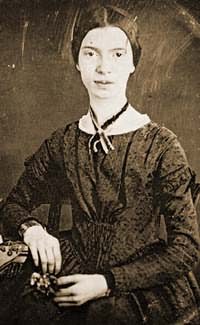
Emily Dickinson (1830-1886)


At school, our English curriculum comprised the classics - Joseph Conrad, Tom Stoppard, King Lear, Chaucer - but with a healthy sideline in eccentricity - Ivor Gurney, Edward Thomas - to keep our fevered teenage imaginations interested. None more so, of course, than Emily Dickinson, the white-clad, ghostlike, hermit of Amherst, with her elliptical fragments of dash-punctuated verse. Eagerly we took her to our puzzled hearts, perhaps because there is something adolescent about much of her work - intense, self-indulgent, romantic.


I can still remember my favourite:


Exultation is the going

Of an inland soul to sea,

Past the houses - past the headlands -

Into deep Eternity.


Bred as we, among the mountains,

Can the sailor understand

The divine intoxication

Of the first league out from land?

Born to a typical New England bourgeois family, Emily was a sickly teenager, but did well at Amherst Academy, where she was particularly interested in geology. At 16, she went to Mount Holyoke Female Seminary, the first women's college in America. Despite her recognized brilliance, she did not fit in, partly because she rejected the dominant Christian revivalist ethos. After periods of ill-health, she was removed from the college at the age of 17.

Emily spent the rest of her days in the family home, The Homestead, in the bedroom overlooking the graveyard. Although at first she would walk her dog Carlo, named after the dog in Jane Eyre, a book she particularly loved, she increasingly began to withdraw from society. For nearly thirty years she looked after her mother, herself an invalid. Her father created a conservatory for her, so she could experience nature without leaving the house: she was a great gardener and amateur botanist. In the last fifteen years of her life she became reclusive, and was protected and supported in her isolation by her father, by her sister Lavinia, and by her sister-in-law Susan "most beloved friend, influence, muse, and adviser" to whom many of the poems were addressed.

Solitary, but demanding of love and attention, Emily was a very active and demanding correspondent, sending her work out to friends for feedback. Her relationships with men were few, intense and conducted mainly through correspondence. Later in life, she had an intimate friendship with a local widower, Judge Otis Lord, reading Shakespeare together, flirting and even sitting on his lap, but when he asked her to marry him, she turned him down.

A recent account of the Dickinson family by Lyndall Gordon maintains that the secret of Emily's seclusion and spinsterdom might lie in epilepsy, a condition which is known to have affected other members of the extended family:

“Nature – sometimes sears a sapling

Sometimes - scalps a tree”

In 1851, aged 20, Emily had privately consulted Dr James Jackson of Boston. Gordon suggests that they spoke candidly about her condition, and that he advised a mode of existence that would mitigate her suffering, and offer her comfort and even fulfillment. Emily was prescribed a solution of glycerine-and-water, one of the nineteenth century nostrums for epilepsy, although at a concentration which suggests to Gordon that it was only ever intended as a placebo. Another doctor advised that it was better to avoid exposure to sunlight, which could exacerbate seizures:

“The Brain within its Groove

Runs evenly”

Until a “Splinter swerve”

The whole affair was kept secret, because epilepsy was at that time so highly stigmatized. The disease was associated with syphilis, masturbation, hysteria, even insanity, and it would have been shaming to the poet and her family had her disability been known. Because seizures might strike at any time with only a few minutes warning, it was better to hide from strangers. To avoid discovery or embarrassment, it was preferable to avoid close contact and never to marry - “by birth a Batchelor”. Becoming a reclusive writer was the ideal solution. Aged 43, she even remained in her bedroom during her father's funeral.

It was perhaps disability, then, which freed Emily Dickinson from the demands made on other late nineteenth century women - marriage, children, social obligations - and which enabled her to express and explore her unique voice. Certainly, many of the poems seem compatible with this suggestion:

"I felt a Funeral, in my Brain,

And Mourners to and fro

Kept treading - treading - till it seemed

That Sense was breaking through."

But retrospective diagnosis is always perilous, and we can never know for sure, as with many historical figures, whether we are justified in claiming them as disabled people.

The locked cherrywood chest against the wall of her bedroom began to fill up with poems, on scraps of paper, loose leaves, but also in 40 handmade booklets which were only discovered after her death, containing over 800 short poems. Poems about flowers, mysterious and passionate love poems, religious poems like demented hymns, and above all poem after poem about death:

"Because I could not stop for Death -

He kindly stopped for me -

The Carriage held but just Ourselves-

And immortality"

Among her influences - Elizabeth Barrett Browning, the Brontes, George Eliot - was the Book of Revelation. Independent in religion as in other areas of life, Emily was inclined to Ralph Waldo Emerson's transcendentalism, rather than conforming to local Protestant orthodoxy:

"Some keep the Sabbath going to Church –

I keep it, staying at Home"

Emily had made several efforts to get her work published, for example exchanging many letters with the critic Thomas Wentworth Higginson and with Samuel Bowles, the editor of The Springfield Republican, a local newspaper, but always with disappointing results. Higginson described the work to a friend as "remarkable, though odd... too delicate - not strong enough to publish." Her frank, obscure and passionate poetry was barely understood or appreciated by contemporaries, and only a dozen examples were published in her lifetime, and in toned-down versions.

After her death at age 55, probably from kidney disease, 1800 poems were discovered by her sister Lavinia. This extraordinary poetic legacy was fought over by her relatives, and particularly by her brother Austin's mistress, Mabel Loomis Todd, who was one of the few to recognise her genius. Todd co-edited a selected volume published in 1890, though with editorial changes to suit contemporary tastes. It took some years, together with much effort to restore the original versions of the work for the 1955 complete edition. By this time, Emily Dickinson had become recognized as one of the greatest, if not the greatest, of all American poets.

Further reading

Emily Dickinson, The Complete Poems, edited by TH Johnson, Faber and Faber 1975.

Lyndall Gordon, Lives like loaded guns: Emily Dickinson and her family’s feuds, Virago 2010.